Trust is the Foundation for Speed
This year’s Hannover Messe event took place from 20 - 24 April, and in cooperation with DSEI Germany, introduced a dedicated area for defence and security: the Defense Production Area. On the Centre Stage, DSEI Germany’s Managing Director Bernd Kögel interviewed Armin Papperger, CEO of Rheinmetall – one of the most influential voices in European defence industry. Their discussion covered: Europe’s global defence posture, supply chain resilience, and the lessons learned from the war in Ukraine. The sense of trust running between industry, government and the armed forces emerged as a central theme – a trust which matters now more than ever before.
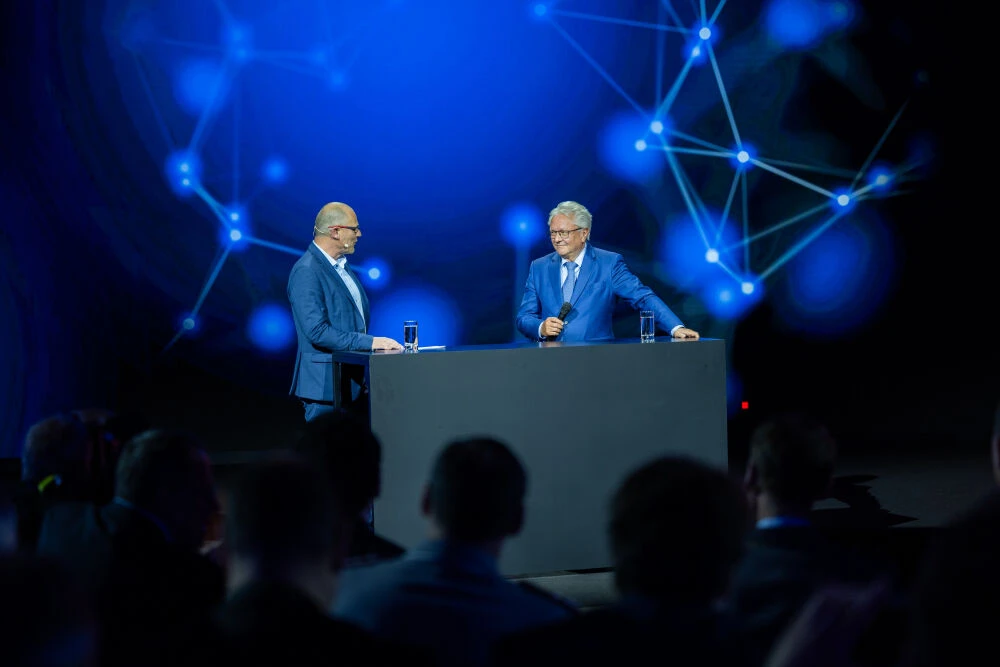
Kögel: We are here at Hannover Messe, where European cooperation is one of the defining themes. My question to you: what does that mean for the defence industry – national paths, or shared European ones?
Papperger: We already work in a very European way -Rheinmetall has a facility in almost every European country. So European cooperation is an absolute must. But it is equally important that countries investing in their own security see jobs created at home. Every prime minister and every defence minister has a responsibility to make sure that works properly – and I believe it already does.
But we have to think not just European – we have to think global. Federal Defence Minister Pistorius visited our facility in Australia two weeks ago. And near Montreal in Canada, we now have over 500 employees. We really do think globally. German policy supports that, and I’m very grateful that we now have significantly better export legislation and much faster decision-making. Partner countries are waiting for German technologies to be implemented with them – and sustainably so.
Kögel: The second question is related: the resilience of the defence industry – the ability to not just keep functioning in times of crisis and conflict, but to scale up. What are the biggest challenges for you as Germany’s largest defence company?
Papperger: The biggest challenge is the supply chain. At Rheinmetall, we conduct a global supply chain analysis every week – very transparently, in close coordination with the ministry: where do we need to build up stocks, and where not.
The solution is clear: for rare earth minerals, for example, you need at least two or three countries from which you can source the same material. That is expensive, because you have to qualify multiple suppliers. But we have approached this consistently. One example: linters are a critical raw material for propellant production. If China stops delivering tomorrow, we need alternative sources. So, we are now building our own linters facility and sourcing the cotton from Australia, Argentina, or Brazil.
In terms of these analyses, Rheinmetall has now reached Tier 5 level. We can’t go all the way down to every mine, but we are very independently positioned. On top of that, we have significantly increased our stockpiles: we currently hold critical goods worth around 8 billion euros in inventory. That’s not good for cash flow – but it’s necessary. And it also helps that larger corporations can support smaller suppliers with their inventory.
Kögel: That’s expensive – the diversification, the multiple source countries. Who pays for that? Does industry bear the cost, or does the public sector client have to contribute?
Papperger: I believe prices will actually come down. For artillery ammunition, we are already five to six percent cheaper than five years ago. And the reason is simple: long-term orders from the Federal Republic of Germany, NATO, and all European states push prices down, not up.
Kögel: You speak with the Ukrainians almost every week. What are you learning from that – in terms of equipping the Bundeswehr?
Papperger: The Ukrainians tell us directly what they need and want. What we have learned: first, automation and autonomous systems are critical – that is occupying everyone at every level. Second, you need effectors: artillery, long-range weapons, etc. We underinvested in that area for years and relied too heavily on nuclear deterrence. That lesson has been learned quickly, and NATO as a whole, is moving strongly in this direction.
When you talk to Ukraine today, air defence is another absolutely critical point. And in general: things change very rapidly. Drones are today a highly effective tool – for engaging unprotected vehicles and personnel. Perhaps in three, four, or five years there will be countermeasures effective enough to shift demand back toward other systems. We can’t know that today. That’s why Rheinmetall invests around 600 million euros annually in research and development.
Kögel: We’re talking about a tripling of the investment share over six years. How do you assess the challenges of this ramp-up for German industry as a whole?
Papperger: German industry as a whole is on a very good path. At Rheinmetall, we have a 30 billion euro investment programme over six years – which of course has to be earned back at some point. But the foundation is there.
We have been building drones for 25 years. In the early days, we built one a month. Today, we are planning production runs of 40,000 to 60,000 units of the FV-014 – or even more. What we learned in the automotive industry helps us here: in our civilian operations, we produced 70,000 solenoid valves a day for the automotive sector – similar electronic components are built into our systems. When the contracts are in place, scaling up is not a problem.
Kögel: One final, more personal question: your public engagement also involves risk. How do you balance statesmanship with entrepreneurial responsibility?
Papperger: The decisive factor is the trust that has been built between government and industry over the past two years. Today, we as an industry frequently act on the basis of handshake agreements – with ministers, for example. Our facility in Unterlüß represents an investment of half a billion euros, with no contract in place at the start. The contract came later. When that trust exists, we also get the speed we need.
We cannot wait for a signed contract and a down payment before we start planning. If we did, we would not be ready by 2029. That trust – between soldiers and industry, between politics and industry – is the foundation. And that is why I am firmly convinced: the project of Germany, the project of Europe, making NATO capable again and protecting ourselves – our children and our grandchildren – will succeed.
Kögel: Thank you very much for the conversation.